
Fire prevention
Building and maintaining firebreaks
The role, limitations and maintenance needs of firebreaks, and the site data required before mechanised work begins.
ZVER · Alpin Jobs EOOD · Bulgaria · EIK 200328636The firebreak is part of a territorial organization to limit the spread and to ensure access. Mere removal of vegetation does not prove that the measure has the correct location, dimensions, connectivity or maintenance.
Planning precedes clearing
Prior to execution, a contractor, a right to work, an approved route and a specific criterion are needed. In forest areas, fire protection measures are planned and controlled according to the applicable forest and fire prevention framework. The owner or user and the competent authorities have roles that the contractor of the mechanized work cannot replace.
What we check in the field
- start, end, intersections and connection with existing roads and open spaces;
- slope, carrying capacity, erosion risk and the possibility of reversing the technique;
- type and quantity of grasses, shrubs, stems, dry matter and fallen wood;
- adjacent plantations, conserved trees, habitats and infrastructure;
- places that require manual work, another machine or separate agreement.
Choice of technology
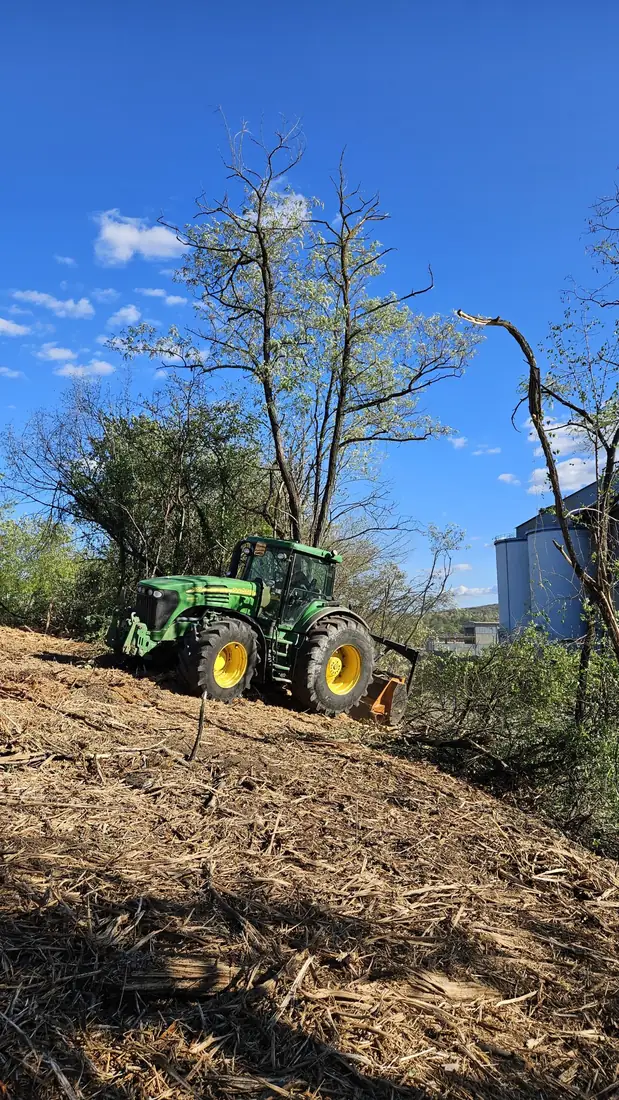
Mulcher can reduce shrub and woody vegetation on site. Excavator or specialized attached equipment supports separation of large elements and work on complex terrain. A specialised milling machine or earthmoving equipment may be required if there is an express requirement to process the residual layer or mineralized strip.
The selection takes into account the risk of stones and metal, sparking, temperature, dry vegetation, wind, extinguishing access and the current fire regime. If the conditions change, the work is stopped or changed according to the preliminary plan.
Combustible material should not simply be moved
Piles of branches and dry material in or next to the work strip can compromise the target. The plan should say what is being shredded, distributed, collected or transported and where. This decision takes into account terrain, permissible direction and future maintenance.
New construction does not eliminate maintenance
Vegetation regenerates, material accumulates, and access changes. A periodic review and threshold for re-intervention is required. Frequency is not invented as a one-size-fits-all term—it follows plan, growth, season, and specific risk.
Verifiable acceptance
Official starting points: The Law on Forests - Fire Protection and Ordinance No. 18 on Inventory and Planning in Forest Territories. The specific measure is checked according to the current version and the approved plan.
Submit the shareable route, length, design criteria, photos, access and expected direction of the material via the contact form.
- The route and processed length match the assigned reference.
- Width and residual vegetation are measured according to an accepted method.
- Access, intersections and stop zones are accounted for.
- The combustible material has a clearly defined destination.
- Photographic and quantitative report is related to sections and date.
Discuss the actual site with our team.
Send the location, approximate area, photographs, access information and required result.