Technical article
Why pushing trees over is not completed clearance
Uprooting alone can leave stumps, roots, unstable ground and mixed material; a finished result requires a defined sequence and acceptance standard.
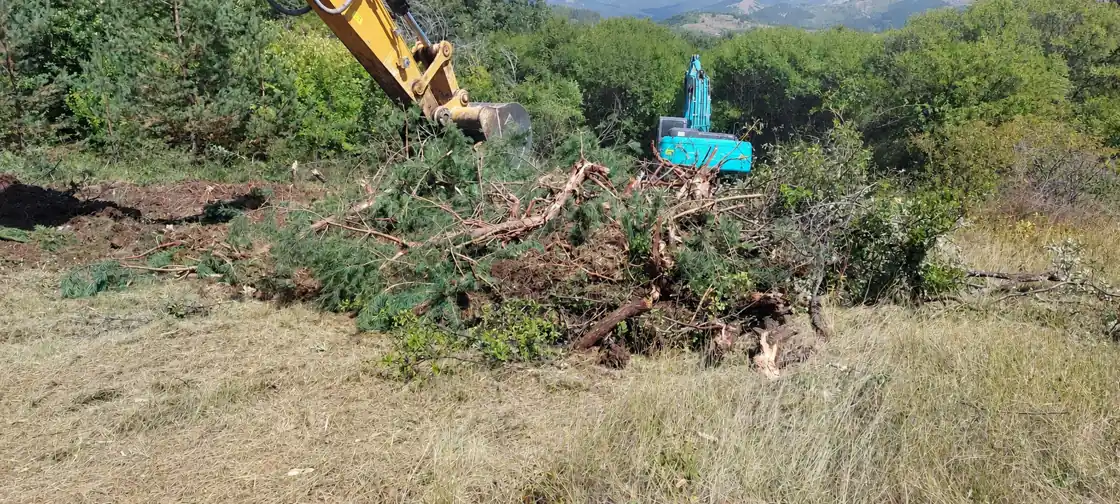
ZVER · Alpin Jobs EOOD · Bulgaria · EIK 200328636At first glance, the terrain appears to be cleared: the trees have been felled, the work area has been cleared, and the vegetation has been piled up at the edge of the property. However, this is often only the first stage. If there is no decision on what to do with the wood mass, the problem is not fixed—it is moved.
Clearing completed is not measured by the number of trees removed alone. It is assessed according to the final condition of the terrain: free boundaries and access, controlled volume of material, specified subsequent use and absence of residual obstacles for agriculture, construction, maintenance or reclamation.
The pile at the end of the field remains part of the task
When pushed with an excavator, trunks, branches, roots and soil are often mixed into bulky and uneven piles. They can take up work space, make it difficult for equipment to pass through, and complicate subsequent sorting.
When boundaries are not pre-established and controlled, there is a risk that some of the material will be pushed or subsequently slide off the work property. Therefore, boundaries, temporary storage areas and responsibility for residual material should be clarified before starting.
Unground material is difficult to move
Whole trunks, crowns and intertwined branches have a large volume and are difficult to compact for transport. Even when the excavator presses or breaks them, the result is not the same as controlled crushing. If hauling is required, this may mean more loading and unloading operations, more haulage trips or additional cutting and preparation.
The exact cost effect cannot be determined without data on the type and amount of vegetation, access, distance to the receiving site, and the treatment method selected. A good offer clearly separates clearance, material handling and transport.
What risks can left piles create?
Dense piles retain moisture and create shaded, sheltered spaces. Depending on the wood species, the health of the material, the season and local conditions, they can be a suitable habitat for insects, fungi or rodents. Diseased or attacked wood may require a phytosanitary assessment and a special treatment method.
Dry material can increase the combustible load on the terrain. This does not mean that every pile is automatically a phytosanitary or fire problem. Risk is assessed specifically by volume, humidity, location, season, nearby objects and applicable regimes.
What does the mulcher change?
The mulcher shreds trunks, branches and brush vegetation into smaller particles. Thus, the initial volume is reduced and the material can be distributed more evenly in a predetermined area. This usually makes access easier and can reduce the need for loading and transport.
When the fragmented organic material is suitable to be left in place, it can participate in the subsequent restoration of the surface layer. However, the thickness and method of spreading must be consistent with the purpose of the terrain. "Processed on site" does not automatically mean "ready for any application".
The mulcher is not a substitute for preliminary inspection, boundary marking, checking utilities and applicable restrictions, waste separation or final profiling. It is a tool in the technological process, not a one-size-fits-all solution.
When material should not simply be mulched in place
The decision should be made after inspection and according to the purpose of the property, not just according to the machine available.
- when there is valuable or usable wood to be separated;
- when the material is contaminated or mixed with waste;
- when there are data on diseases, pests or special phytosanitary requirements;
- when the terrain falls into a protected regime or there are restrictions on the removal and treatment of vegetation;
- when the future construction project does not allow organic material in the foundation, embankment or infrastructure areas;
- when slope, soil, access or risk to surrounding objects make mulcher operation unsuitable.
Pushing alone versus planned completion
With pushing and piling alone
- part of the area remains occupied by bulky piles;
- the material may require additional cutting, loading and transportation;
- without boundary control there remains a risk of encroachment or landslide outside the marked work boundaries;
- the subsequent use of the field may remain unspecified.
With planned completion
- the zones, boundaries and final state are defined in advance;
- for each material there is a solution: preservation, shredding, spreading or removal;
- transportation is planned according to the actual material and receiving location;
- the result is tailored to agriculture, construction, maintenance or reclamation.
What a properly completed process looks like
- documented authority to commission the work, working boundaries and preservation zones are established;
- access, slopes, known networks and applicable modes are checked;
- separate streams are described: valuable wood, branches and bushes, stumps and roots, soil, stones and waste;
- a decision is chosen for each flow — retention, shredding, controlled spreading, removal or transmission as applicable;
- mechanised clearance is carried out within the marked boundaries;
- if necessary, collection of residues, profiling, anti-erosion measures and restoration of the surface layer are carried out;
- the final result is documented with photos, quantities and acceptance according to the agreed scope.
The difference is in the end result
The excavator is suitable for demolishing, uprooting, moving and shaping work areas. The mulcher is suitable for controlled shredding and volume reduction of certain types of vegetation. Removal is necessary when the material cannot or should not remain in place. For many sites, the best result comes from the right combination, not a single machine.
Therefore, the question is not "excavator or mulcher", but "what condition should the terrain have in the end". When the objective is clear already at the inspection, the technology, quantities, transport and acceptance criteria can be planned in advance.
Related Materials and Services
See terrain clearance, forestry mulching, selective clearance, root milling, land reclamation, the guide to mulching or removing material, and the documented process for handling removed stumps and roots.
Send photos and data about the terrain: approximate area, location and future purpose. We will prepare inspection questions and realistic options for crushing, hauling and finishing.
Discuss the actual site with our team.
Send the location, approximate area, photographs, access information and required result.